The Outcome
The Compounding Returns of Clean Data
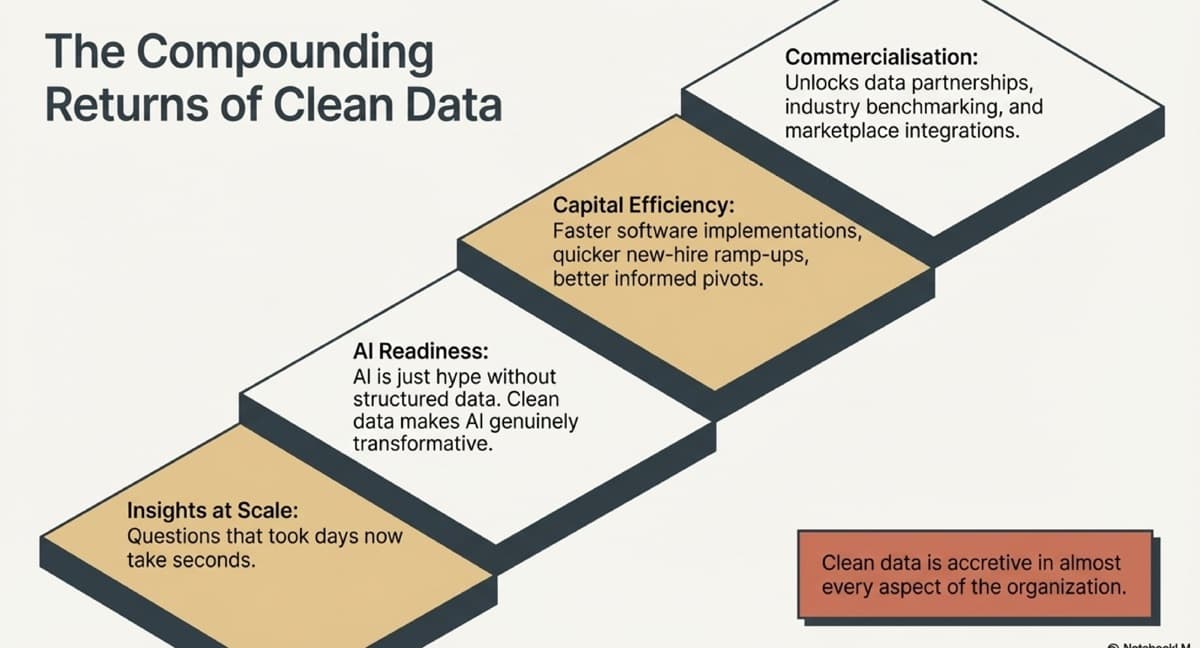
Clean data is accretive in almost every aspect of your organisation.
The value of clean, structured data does not arrive all at once. It compounds. Like a well-architected codebase or a strong balance sheet, a data foundation creates increasing returns over time as you layer capabilities on top of it. McKinsey found that data-driven organisations are 23 times more likely to acquire customers1 — and that advantage only grows as data quality improves. The businesses that invest in their data foundation early do not just solve today's reporting problem — they create an asset that appreciates in value with every decision it enables.
23x
more likely to acquire customers for data-driven organisations
McKinsey, 2020
Insights at Scale
The first return is immediate: questions that used to take days now take seconds. Your leadership team can query a single, reliable data layer instead of waiting for someone to assemble a report from five different systems. This alone changes the pace of decision-making. But the compounding effect is that as your team gets used to having fast answers, they start asking better questions. The quality of strategic thinking improves because the constraint is no longer data access — it is imagination.
AI Readiness
AI is just hype without structured data. But with a clean data foundation, AI becomes genuinely transformative. Forecasting models have reliable historical data to learn from. Classification models can segment customers, products, and markets accurately. Agentic AI systems can operate autonomously because they have a trustworthy data layer to make decisions against. Every month that your data foundation operates cleanly, your AI training data improves — making future AI capabilities more accurate and more valuable.
Clean data is accretive in almost every aspect of the organisation.
Capital Efficiency
Clean data makes your business more capital-efficient in measurable ways. Software implementations take weeks instead of months because the data is ready. New hires ramp up faster because there is a single source of truth, not tribal knowledge. Forrester research shows that insights-driven businesses grow at an average of 30% annually2. Strategic pivots are better informed because you can model scenarios against reliable data. Each of these efficiencies is modest on its own. Together, they represent a significant reduction in the cost of running and growing your business.
Commercialisation
For businesses with sufficient data volume, clean data unlocks entirely new value streams. Data partnerships with complementary businesses. Industry benchmarking products. Marketplace integrations that require structured, standardised data feeds. These opportunities are invisible when your data is messy. They become obvious — and accessible — once your data is clean and structured.
Valuation Impact
Clean data is a valuation multiplier. In due diligence, the ability to produce reliable numbers on demand signals operational maturity. It reduces perceived risk, accelerates the diligence timeline, and supports higher multiples. Conversely, messy data is a valuation discount — it signals operational fragility and hidden risk. Whether you are raising capital, preparing for acquisition, or building a business you intend to run for decades, the data foundation pays for itself many times over.
Sources
- McKinsey Global Institute, "The Age of Analytics" (2020)
- Forrester, "Insights-Driven Businesses Set the Pace for Global Growth" (2021)
Related Capabilities
Data Strategy & Architecture
Before any technology investment, the architecture and governance must be right. We define data strategy aligned to commercial objectives — the roadmap, standards, and operating model that turn raw data into a durable competitive asset.
Applied AI & Intelligent Automation
AI is only valuable when it solves a real problem with measurable return. We apply machine learning, intelligent automation, and autonomous AI systems to challenges where the impact justifies the investment.
Continue Reading
The Foundation
What Is a Data Foundation (And Why It Matters)
A data foundation is the structured, connected data layer that powers every reliable decision, dashboard, and AI capability in your business. Learn what it is and why it is the most important investment you can make.
Read →The Outcome
How Clean Data Increases Company Valuation
Clean data is a valuation multiplier. Messy data is a discount. Learn how data quality directly impacts due diligence, investor confidence, and exit multiples.
Read →Ready to build your data foundation?
Let's have a conversation about where you are and whether data foundations are the right investment right now.
Start a Conversation